
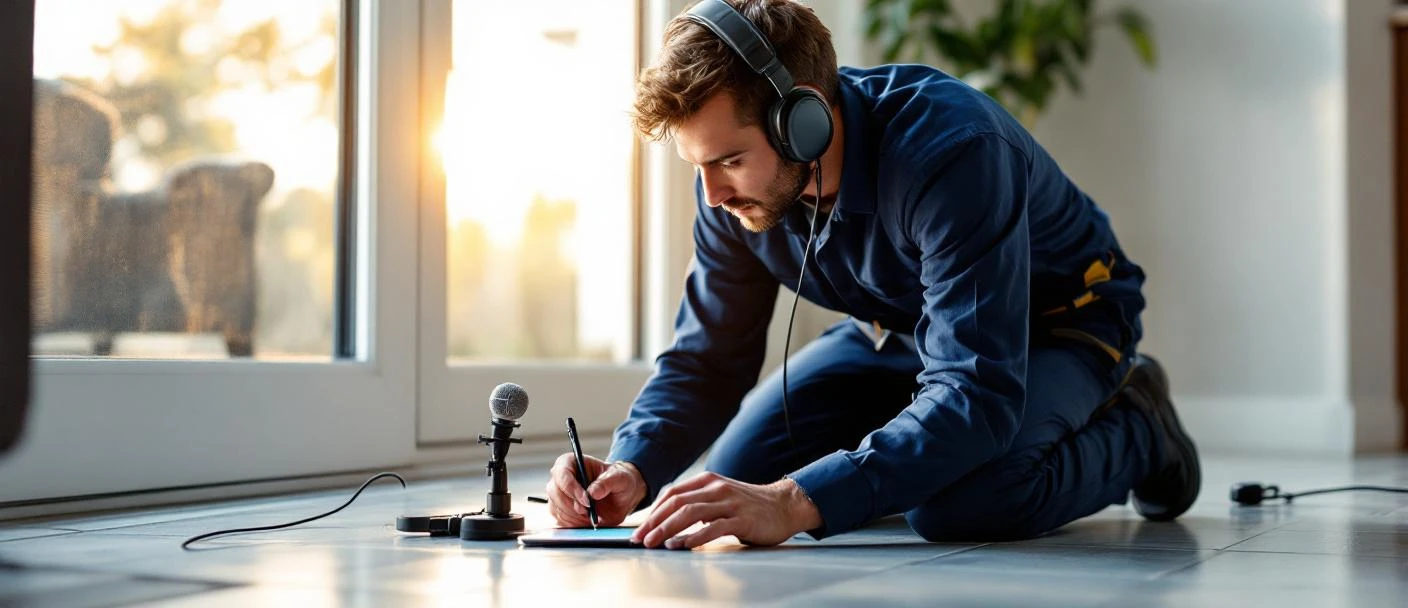
Slab Leak Detection Chattanooga TN — when water is moving beneath your concrete foundation but you can’t see it, the diagnostic order is acoustic listening first, thermal imaging second, tracer gas as needed. Plumbers in our network arrive with Fluke ALD-2 ground microphones, FLIR thermal cameras, and helium tracer gas equipment to pinpoint the leak before any concrete is opened. Repair options include through-slab spot repair or full pipe reroute via attic or interior walls.
A slab leak doesn’t announce itself the way a burst pipe does. The water has nowhere to go but into the substrate beneath the concrete and along the path of least resistance. By the time symptoms appear at the floor surface — a warm spot, a damp carpet edge, a sound of running water — the leak has been progressing for weeks or months. Early detection saves both the leak repair cost and the damage cost.
What Detection and Repair Costs Look Like in Chattanooga
Detection alone runs $385-$985 depending on method depth. Through-slab spot repair runs $1,850-$3,850 . Reroute via attic runs $2,850-$5,500 . Full home repipe with slab abandonment runs $8,500-$18,500 . The cost spread reflects very different repair scopes — the right answer depends on the specific leak and the home’s overall plumbing condition.
Symptoms That Tell You Water Is Moving Beneath the Concrete
Warning Signs to Watch For
- Unexpected warm spot on tile or hardwood floor
- Sound of running water with no fixtures on
- Water bill 30%+ higher than baseline with no explanation
- Damp carpet or baseboard at base of wall on slab homes
- Tile cracking or settlement in concentrated area
- Mold or mildew smell with no visible source
- Hot water heater running more than usual
- Water meter triangle rotating with all fixtures off
The water-meter test is the cheapest and most reliable first-pass diagnostic any homeowner can run. Walk to the meter (typically curb-side in 37411 Brainerd, in the front lawn parkway), shut every fixture in the house including ice makers and humidifiers, watch the meter for 5 minutes. If the indicator triangle moves at all, water is flowing somewhere on the system.
Step-by-Step Methods Our Plumbers Use to Pinpoint Slab Leaks
- 1
Pressure Decay Test
Confirm a leak exists and isolate hot vs. cold side via system shutoff sequencing.
- 2
Acoustic Walk-Down
Ground microphone room-by-room to localize leak signal.
- 3
Thermal Sweep
FLIR camera on hot-side runs to identify thermal halo through slab.
- 4
Tracer Gas (if needed)
Helium-95% / nitrogen-5% mix charges the line; sniffer probe locates emergence point.
- 5
Pinpoint Mark
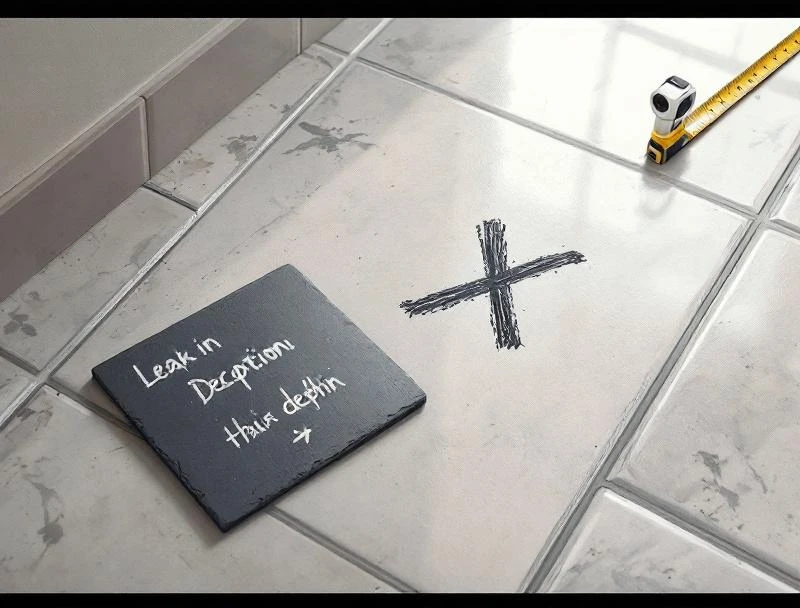
Marker paint X with depth note. Repair scope decision: spot vs. reroute.
- 1
Pressure Decay Test
Confirm a leak exists and isolate hot vs. cold side via system shutoff sequencing.
- 2
Acoustic Walk-Down
Ground microphone room-by-room to localize leak signal.
- 3
Thermal Sweep
FLIR camera on hot-side runs to identify thermal halo through slab.
- 4
Tracer Gas (if needed)
Helium-95% / nitrogen-5% mix charges the line; sniffer probe locates emergence point.
- 5
Pinpoint Mark
Marker paint X with depth note. Repair scope decision: spot vs. reroute.
Rare under-slab freeze events in mountain-elevation 37377 homes are handled separately by our frozen pipe repair team.
Acoustic, Thermal, Tracer-Gas, and Pressure Isolation Compared
Acoustic listening with a ground microphone (Fluke ALD-2, SubSurface LD-12) detects the high-frequency hiss of pressurized water escaping from a pinhole. Effective on slabs of typical residential thickness (4-6”) and works through tile, vinyl, and most carpet pad. Less effective on thick or heavily-reinforced slabs.
Thermal imaging (FLIR E8-XT, E96, T540) detects the temperature differential between hot-water lines under the slab and the surrounding concrete. The thermal halo at the leak location is brighter than the surrounding line because the water is exchanging heat directly with substrate. Effective on hot-side leaks; less effective on cold-side because the temperature differential is smaller.
Helium tracer gas (helium 95% / nitrogen 5% mix per ASTM E2106) is used when acoustic and thermal can’t pinpoint. Procedure: evacuate the suspect line, charge with tracer gas, scan the floor with a sniffer probe. The gas rises through the slab to the surface at the leak emergence point. Highly accurate but slow; deployed when other methods aren’t sufficient.
Pressure decay testing isolates which side of the system has the leak. Hot-only decay points at the hot loop; cold-only at the cold loop. Decay rate quantifies leak severity (slow vs. fast).
Acoustic Leak Listening
The ground microphone is the workhorse tool. Fluke ALD-2 deck-plate listening pad picks up vibration from the pipe wall transmitted through the slab. A trained ear discriminates leak hiss from ambient noise, HVAC, and other plumbing flow.
Best results come from listening during a quiet period — early morning before HVAC cycling peaks. Shut HVAC, refrigerator, and ice-maker systems during the listen for cleanest signal. Frequency filtering on the LD-12 helps isolate leak signal from low-frequency rumble.
Electronic Line Tracing
Pipe tracing maps the path of the supply line under the slab before pinpointing the leak location along that path. A signal generator induces a tracking signal into the copper; a receiver wand at the floor surface picks up the signal as the pipe passes underneath. Once the path is mapped, acoustic listening focuses on the path rather than scanning blind.
Thermal Imaging on Slab
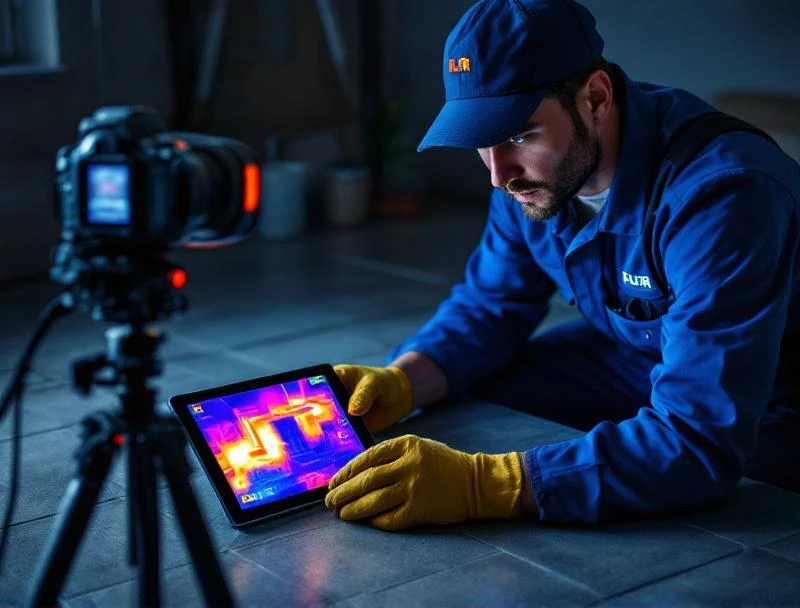
The FLIR camera shows surface temperature in real time. Hot-water lines under tile or hardwood show as faintly warmer lines on the thermal image. At the leak point, the warmth concentrates because water is exchanging heat with the substrate at higher rate than along the unbroken line.
Emissivity adjustment matters — concrete, tile, and hardwood have different emissivity values that affect apparent temperature. Calibration on a known-temperature surface (your hand) before the scan provides reference.
Pressure Isolation Testing
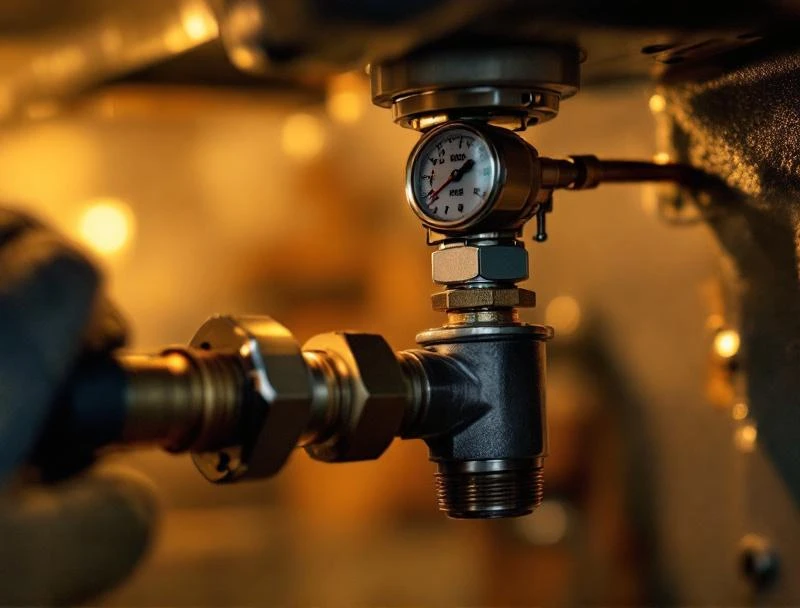
Section isolation lets us separate the leak’s location into manageable zones. Shut at the water heater outlet to isolate hot-only; shut at the cold inlet to isolate hot+cold; shut at individual angle stops to isolate per-fixture. Decay rate at each isolation step tells us which sub-section contains the leak.
A typical decay benchmark: 1 PSI over 5 minutes is acceptable seal; faster decay indicates active leak. The rate quantifies severity — 5 PSI per minute is a major leak, 1 PSI over 30 minutes is a slow weep.
Helium Tracer Gas Detection
When other methods can’t pinpoint (thick slab, heavily-reinforced concrete, deeply-embedded line), helium tracer gas is the fallback. The procedure: shut and drain the suspect section, charge with helium-95% / nitrogen-5% mix to 30 PSI, walk the floor with a sniffer probe (SewerIn HG10 or Inficon Wey-TEK).
Helium has the smallest molecular size of any inert gas, so it migrates through small leaks that water-pressure tests might miss. The sniffer probe localizes the leak to within inches.
Hot-side slab leaks dominate at 70% of calls
Hot-side leaks make up approximately 70% of slab-leak calls in Chattanooga. The reasons stack: copper expands and contracts thermally against gravel and rebar, runs at higher chloramine reactivity, and recirculation loops carry continuous flow. The 1995-2010 building window in 37421 East Brainerd installed many recirculation systems that are now reaching the 15-25 year leak-emergence window.
Slab Spot Repair
Through-slab spot repair is the lowest-cost method when the leak is at a single accessible point. The scope: mark the leak location, saw-cut the slab opening (typically 24” x 24” for working room), jackhammer down to the line, replace the affected pipe section with new copper or PEX, pressure-test, patch the slab with high-early-strength concrete tied to existing rebar.
The patched slab requires 24-48 hours to cure to full structural strength before finish floor (tile, hardwood, carpet) goes back. Total disruption: 4-8 hours of plumbing work plus 1-3 days of finish restoration.
Slab Line Rerouting
When the leak is the second or third on the same supply loop, spot repair becomes a losing strategy — the pipe is failing systemically and more leaks are coming. Rerouting abandons the under-slab line entirely. New PEX-A runs through the attic, drops down interior walls to fixture stub-outs, ties into the existing system at the manifold or supply tee.
For 37421 East Brainerd ranches with hot-water recirculation loops, the reroute typically includes a manabloc PEX manifold install with individual shut-offs for each fixture — a meaningful future-maintenance upgrade beyond just solving the current leak.
Foundation Moisture Damage Assessment
Post-leak moisture mapping with a Tramex CME-4 pinless meter shows the extent of substrate saturation. Calcium-chloride RH testing quantifies the moisture remaining in the concrete after surface drying — a key data point for whether finish floor (especially hardwood and tile with vinyl backing) can go back without trapping moisture.
Drying typically takes 3-7 days with dehumidifier and air-mover support. Floor finish replacement happens after the calcium-chloride test confirms moisture is at acceptable level.
Hot-Water-Loop Slab Leaks
Recirculation loops in 37421 East Brainerd 1995-2010 builds are the dominant Chattanooga slab-leak source. The continuous flow accelerates copper fatigue beyond what static-flow systems experience. By year 15-20, pinhole leaks emerge — usually first on the hot return line (which runs 24/7) before the supply line.
When we identify a recirc-loop slab leak, the recommended scope is full reroute of the recirc loop rather than spot repair. The other side of the loop is likely to fail within 1-3 years, so the second leak will arrive before the first repair has fully amortized.
Soft-Copper Under-Slab Repair
Under-slab supply lines are typically Type L coil copper laid on the gravel sub-base before slab pour. Tennessee Plumbing Code §305.6 requires corrosion protection (sleeve or wrap) — many 1980s Chattanooga homes were installed without compliant sleeving, which contributes to early failure rates.
Pipes installed in or under concrete shall be protected from corrosion. Approved methods include polyethylene sleeves, foam-wrap insulation, or PEX-A tubing rated for under-slab service. Many 1970s-1980s Chattanooga homes were installed without compliant protection, which contributes to early failure rates in 37411 ranches and similar-era builds.
Why Hot-Side Slab Leaks in 37411 Ranches Are So Common
37411 Brainerd ranches built 1955-1975 have slab-on-grade construction with under-slab copper laid before code required corrosion protection. The combination of unsleeved Type M copper, chloramine in the water, and 50+ years of thermal cycling produces a predictable failure pattern. Most leaks are hot-side because the hot loop runs hotter and cycles more.
When one leak is found in a 37411 ranch, additional leaks typically follow within 1-3 years on the same loop. The economic argument shifts in favor of full reroute via attic plus copper-line abandonment.
Above-grade leaks have a different signature — wall leak detection uses thermal and acoustic methods tuned to drywall.
Recirculation-loop slab leaks frequently overlap with water heater repair when the recirc pump is the heat source.
Tennessee Code on Re-Routing vs Spot-Repair Decisions
Tennessee Plumbing Code now permits PEX-A under-slab installation with sleeve. Most reroutes use PEX-A in the attic rather than re-installing copper because PEX-A handles thermal expansion better and isn’t subject to chloramine pitting. Manabloc manifold systems (Uponor Wirsbo, Viega) provide individual shut-offs for each fixture, simplifying future maintenance.
Suspect a slab leak?
The water-meter triangle test is free and takes 5 minutes. If the triangle moves with all fixtures off, call us.
When Spot Repair Through the Slab Is Smarter Than Re-Routing
| Situation | Spot Repair | Reroute |
|---|---|---|
| First-time leak on copper under 15 years old | Yes — repair | — |
| Cold-side leak, no recirc loop | Yes — repair | — |
| Single accessible leak, finished floor not extensive | Yes — repair | — |
| Second leak on same loop | — | Yes — reroute |
| Copper over 25 years old, multiple symptoms | — | Yes — full repipe |
| Recirculation loop hot-side leak | — | Yes — reroute or full |
| Polybutylene under slab | — | Yes — reroute mandatory |
| Whole-home symptoms, not single point | — | Yes — full repipe |
Slab-on-grade construction dominates Chattanooga homes built 1970-2010. Concentrations: 37421 East Brainerd, 37343 Hixson, 37363 Ooltewah subdivisions. Hamilton County clay-soil pockets in 37343 cause seasonal slab movement that physically stresses under-slab joints, accelerating leak development beyond the chemistry-only timeline. 37377 Signal Mountain split-foyer homes often involve lower-level slab over an unconditioned crawlspace — different access strategy than full-slab homes.
If water is actively pooling in the home, an active leak emergency in 37405 takes priority over scheduled detection.
Why a Warm Spot on Your Floor Means Faster Action Saves Money
A warm spot on the floor means a hot-water line is leaking under the slab and exchanging heat with the surface. Every day of leak operation pumps additional water into the substrate, expanding the moisture-damaged area, and adds to the foundation moisture remediation cost. A leak detected and repaired in week 1 typically costs $2,500-$4,500 total. The same leak ignored for 3 months runs $8,000+ once foundation drying and finish replacement enter scope.
Brands & Equipment
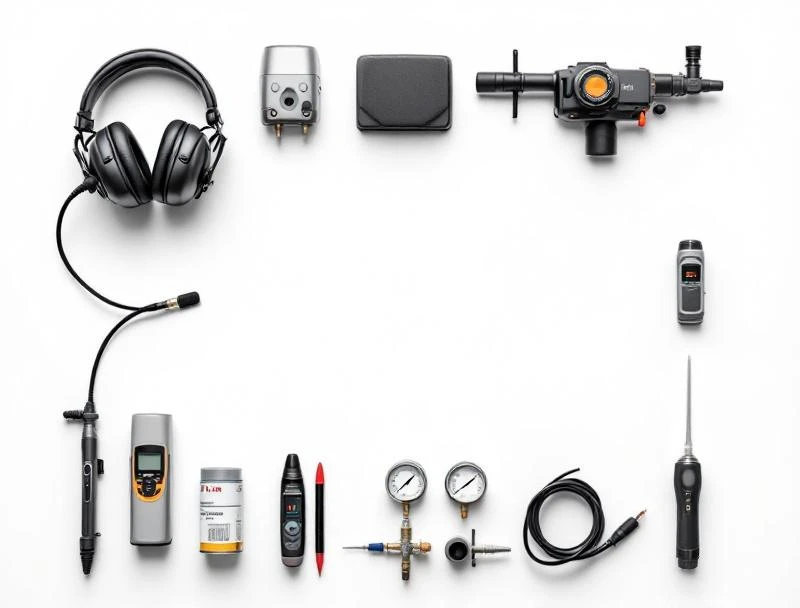
Detection Equipment We Use
Service Cost Calculator
Quick Estimate
Estimates are approximate. Call for written quote.
What Every Service Call Includes
What Every Service Call Includes
- Written estimate before any work begins
- Upfront pricing with no hidden fees
- Bonded and insured plumbers in our network
- Background-checked plumbers dispatched to your home
- Same-day emergency response across Hamilton County
- Workmanship stands behind the repair
Stats
When a slab leak starts flooding finished rooms overnight, Emergency Plumber Chattanooga dispatches both detection and repair on the same call.
What This Service Costs in Chattanooga
| Service | Chattanooga Range | Time Required |
|---|---|---|
| Acoustic detection only, single-line (37411) | $385 – $685 | 1 – 2 hours |
| Full multi-method detection (37343) | $585 – $985 | 2 – 4 hours |
| Hot-side spot repair through slab (37411) | $1,850 – $3,850 | 4 – 8 hours |
| Cold-side spot repair through slab (37416) | $1,650 – $3,650 | 4 – 7 hours |
| Recirc-loop reroute via attic (37421) | $2,850 – $5,500 | 1 – 2 days |
| Full home repipe with slab abandonment (1,800 sq ft) | $8,500 – $18,500 | 3 – 5 days |
| Tracer gas detection only (difficult slab) | $685 – $1,250 | 3 – 5 hours |
| Foundation moisture remediation post-leak | $485 – $1,650 | 1 – 3 days |
| Insurance documentation report only | $185 – $345 | 1 – 2 hours |
| Manabloc PEX manifold install during reroute | $685 – $1,250 | 4 – 6 hours |
| PRV replacement during slab-leak repair | $385 – $585 | 1 – 2 hours |
| Concrete patch and floor restoration (24"x24") | $485 – $985 | 1 day |