
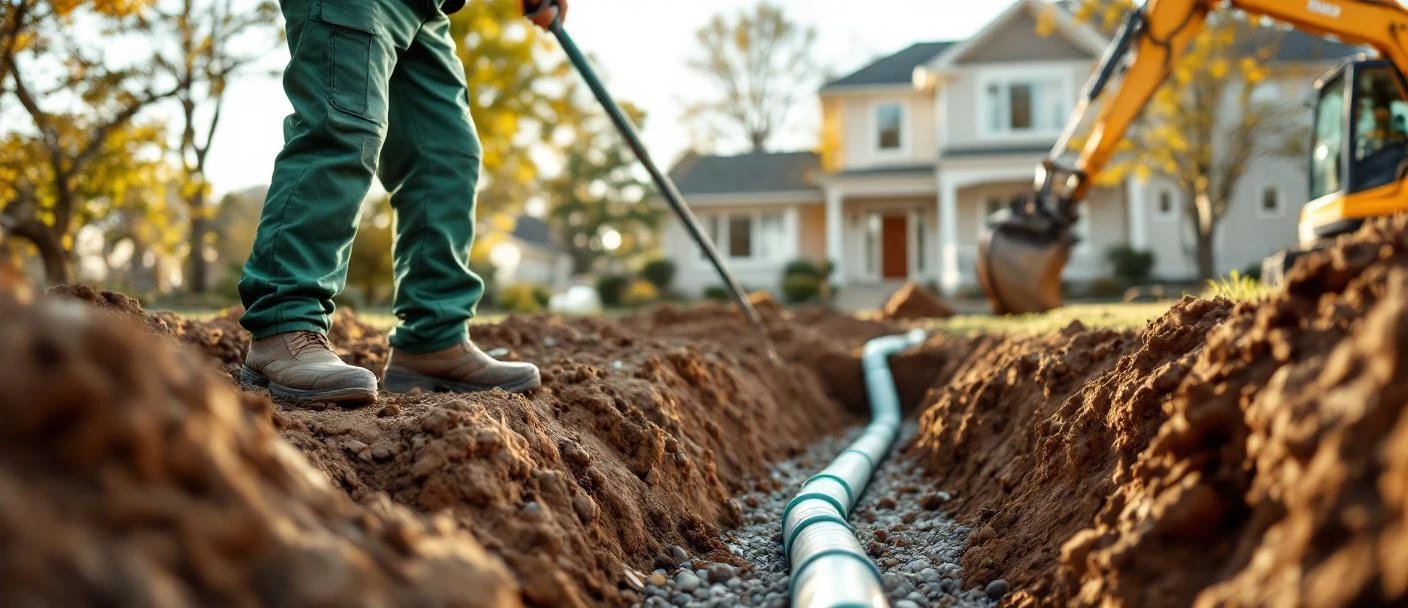
Sewer Line Repair Chattanooga TN — when your lateral has failed, the question is which method gets the line back in service with the least disruption to your yard, driveway, and budget. Plumbers in our network arrive with camera, sonde, hydrojetter, and the equipment for trenchless CIPP lining, pipe bursting, or open-trench replacement as the situation demands. From sewer scope home-buyer inspection through full lateral replacement with restoration.
A failed sewer lateral is the highest-stakes residential plumbing scope. The cost spread is large ($1,850 spot repair to $18,500 full open-trench replacement), the work is permitted, and the wrong method choice produces results that don’t last. Diagnosis comes first — always camera before commitment to a repair method.
What Sewer Repair Costs Range Look Like in Chattanooga
The price gap between methods reflects very different scopes. Spot repair (open-trench, single section) on an accessible lateral runs $1,850-$3,850 . Trenchless CIPP lining of a typical 50-foot lateral runs $5,500-$11,500 . Pipe bursting (HDPE pull-through) runs $7,800-$14,500 . Full open-trench replacement with sidewalk, driveway, and landscaping restoration runs $8,500-$18,500 .
How to Tell a Lateral Failure From a Main-Line Backup
Lateral failure usually starts as a slow main-drain backup that progresses to a full backup. Symptoms include water surfacing in the yard above the lateral run, sewer odor outside near the cleanout, repeated unclogs that work for shorter intervals, and bubbles in the lowest fixture (basement floor drain or shower pan) when other fixtures drain.
Warning Signs to Watch For
- Soggy patch in yard following the lateral path
- Sewer odor near exterior cleanout
- Recurring main-line backups within weeks
- Roots emerging from cleanout when cap removed
- Multi-fixture backup that resists snake clearing
- Sinkhole or depression along the lateral run
- Vivid green grass strip above the lateral (effluent fertilizing)
- Unexplained increase in service charges from city water (leak side)
If the issue is a single fixture, our Chattanooga drain service handles it without the larger-scale repair scope.
How Camera Inspection Documents the Real Damage
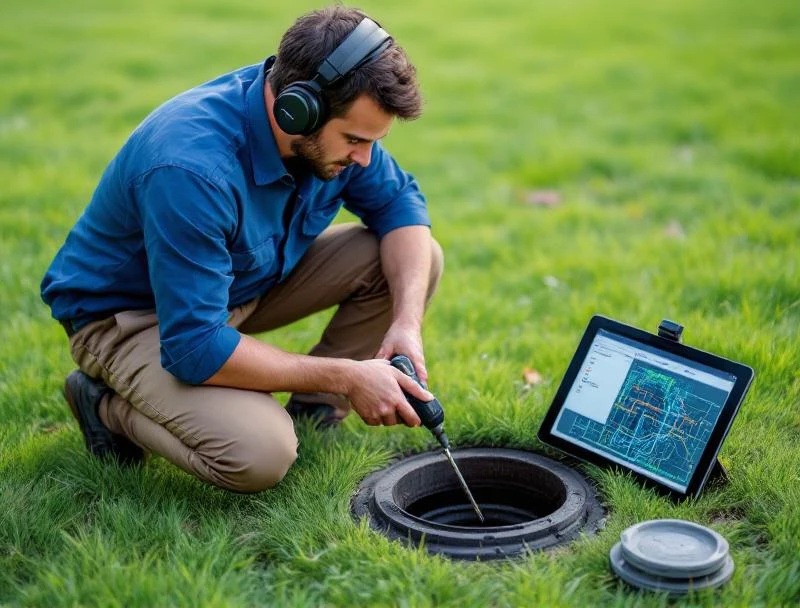
The sewer camera (RIDGID SeeSnake CS65, Hathorn Pearpoint flexitrax) feeds a self-leveling head down the lateral via a push-cable. The head transmits video to a recorder; a sonde transmitter at the head broadcasts a locator signal that the sonde wand picks up at ground level. The combination tells us exactly where each defect is — distance from the cleanout and depth below grade.
NASSCO PACP grading codes the defects: cracked, fractured, broken, deformed, hole, separated joint, root intrusion, scale, sediment, capacity reduction. The grading determines which repair method applies. Light defects (single root intrusion at one joint) repair with spot work; systemic defects (multiple offsets, full deformation) require full replacement.
Hot water signals beneath the foundation are not sewer issues — slab leak detection uses different equipment.
Trenchless Pipe Lining (CIPP)
Cured-in-place pipe (CIPP) lining is the highest-margin trenchless method. The process: pre-clean the lateral via hydrojetting, invert a felt liner saturated with epoxy resin into the pipe via inversion drum, cure the resin (ambient, steam, or UV depending on system), reinstate any lateral connections via robotic cutter, post-camera verification.
The cured liner is structurally independent — it doesn’t rely on the host pipe for support. 50-year design life per ASTM F1216. Common systems used in Chattanooga: Perma-Liner Industries, MaxLiner USA, NuFlow, LMK Performance.
CIPP can’t be used when the host pipe is severely collapsed (deformation greater than the liner can flex through) or when the lateral has too many active connections to reinstate cleanly. In those cases, pipe bursting is the alternative trenchless method.
Pipe Bursting
Pipe bursting uses a pneumatic splitter head pulled through the existing pipe via a winch. The splitter fragments the old pipe outward into the surrounding soil while simultaneously pulling new HDPE pipe behind it. End result: full diameter (or upsized) HDPE pipe in place of failed clay or cast iron, with only entry and exit pits dug.
Common systems: TT Technologies Grundoburst, HammerHead 4000, TRIC Tools. HDPE pipe (WL Plastics, Dura-Line, JM Eagle) is fused at butt or electrofusion joints — no joint failures because there are essentially no joints in the new line.
Sewer Lateral Replacement
When trenchless methods can’t apply, open-trench replacement is the fallback. The scope: locate and mark the lateral with sonde, excavate from house to property line in 4-foot-wide trench, remove old pipe, lay new SDR-35 PVC on a 4” gravel bed at proper slope (1/4” per foot minimum for 4” pipe), backfill in 6” lifts with compaction, restore landscaping, sidewalk, or driveway.
A typical 75-foot replacement on a Chattanooga property with no concrete restoration runs $8,500-$12,500 . Add concrete sidewalk or driveway and the cost climbs to $15,000-$18,500 .
Tree Root Removal
Roots invade clay-tile laterals at the joints. The repair sequence: hydrojet pre-clear to expose the root mass, root-cutter chain knocker spinning at the affected joint, foaming herbicide treatment with dichlobenil active ingredient (RootX) to retard regrowth, post-camera verification of clearance.
Without herbicide treatment, roots typically return within 6-12 months in 37343 Hixson clay-soil zones. With annual treatment, the interval extends to 24-36 months. The durable fix is replacement of the affected lateral section.
Sewer Scope Real Estate Inspection
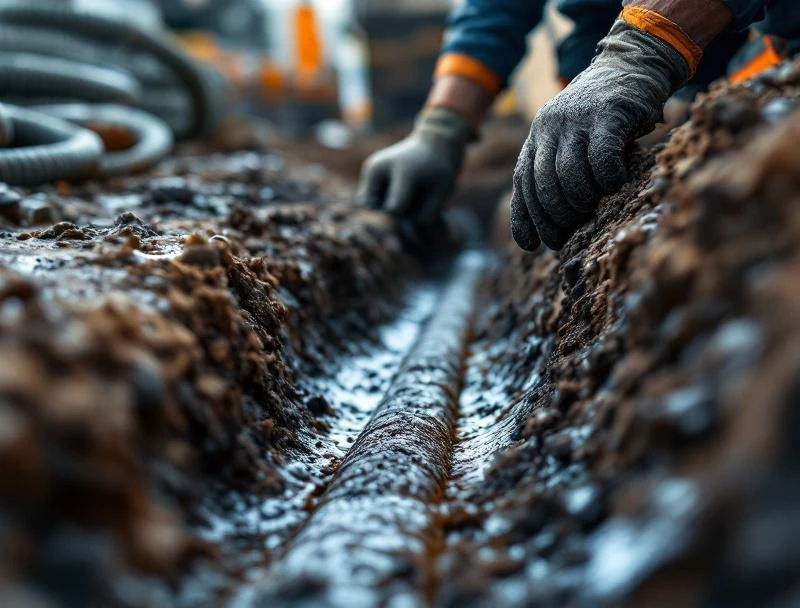
Pre-purchase sewer scope inspection is increasingly standard for Chattanooga real estate transactions, particularly for homes built before 2000. The inspection runs the camera from the cleanout to the city main connection and produces a video file plus written summary. Total cost $385-$585 ; total time 1-2 hours including report.
Common findings on pre-purchase scopes: minor root intrusion (often within tolerance), sediment buildup (cleanable), partial offset at one joint (monitor or repair), Orangeburg pipe identification (replacement-grade finding). Buyers use the report to negotiate repair allowances or contingency removal.
Backflow Prevention
Backwater valves on the sewer side prevent city-main backups from entering the home. Flapper-style valves (Mainline Backflow MB-3-3-PVC, Sioux Chief) install in a pit at the building drain exit. RPZ valves and double-check assemblies are for water-supply backflow (irrigation, fire sprinkler) — different application.
Tennessee American Water requires backflow preventers on irrigation systems and fire sprinklers; the assemblies must be tested annually by a Tennessee certified backflow tester. We handle both the install and the annual test.
Cleanout Installation
A two-way cleanout at the property exit is the highest-leverage drainage upgrade for any older Chattanooga home. It allows snaking and hydrojetting toward both the house and the city main from a single access point. The install scope: locate the lateral, excavate to the lateral, cut in a 4” PVC two-way cleanout assembly with brass cap, restore.
Tennessee Plumbing Code §708.1.6 requires a two-way cleanout where the building drain exits the structure — many pre-1970 Chattanooga homes lack this and add it during repair.
Main Sewer Line Locating
Locating uses a sonde transmitter at the camera head broadcasting a signal that a locator wand (RIDGID Navitrack II, SR-20; Vivax-Metrotech vLoc) picks up at ground level. The wand reads both lateral position and depth. For non-conductive pipe (PVC) where signal traces aren’t possible, ground-penetrating radar (GPR) provides backup locating.
Sewage backing up right now?
Stop using water and call. Continued use makes the cleanup worse.
Sewer Ejector Pumps
Below-grade fixtures (basement bathrooms, finished basement bars) discharge into a sewer ejector pump pit since gravity can’t carry waste up to the building drain. Common pumps: Liberty Pumps LE51 and ProVore, Zoeller M267 and M53, Saniflo Sanibest, Hydromatic.
Solids-handling pumps (2” passage minimum) are required for toilet discharge; effluent pumps handle gray water only. Failure modes include float switch stuck, motor seized, check valve flapper stuck. Replacement of a Liberty LE51 in a 37405 historic basement runs $1,850-$2,850 .
Polybutylene Pipe Identification
While polybutylene is rare in sewer laterals (it was a supply pipe), occasionally we encounter PB used incorrectly as drain pipe in 1980s additions. Identification matters because Tennessee §605 prohibits PB in sewer applications, so finding it triggers replacement scope.
Brands & Equipment
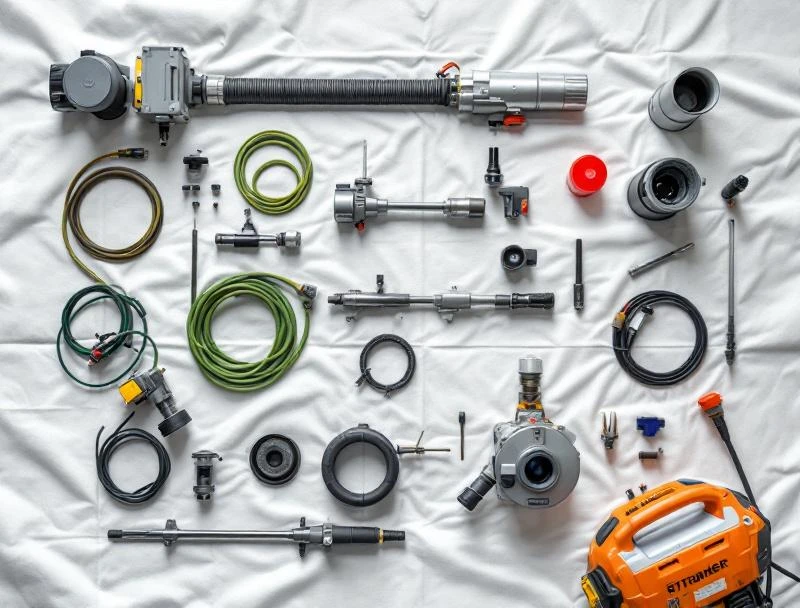
Sewer Repair Equipment & Materials
Why Clay Tile Laterals in 37402 and 37405 Fail Predictably
Pre-1940 housing in 37402 and 37405 represents about 25% of Chattanooga’s housing stock, and most still have clay-tile sewer laterals. The hub-and-spigot joints sealed with oakum and lead have a typical service life of 60-90 years — putting most current installations in failure window.
The failure mode is usually joint offset rather than pipe-wall failure. Soil shifts over decades, the bell end of one section moves relative to the spigot end of the next, and the joint opens enough for roots and soil to enter. Once that starts, the offset grows and the lateral progressively narrows.
Orangeburg pipe is its own failure category
Orangeburg sewer pipe (bituminized fiber, used 1948-1972) appears in some 37411 Brainerd post-WWII subdivisions. Failure mode: deformation under soil load — the pipe collapses ovaloid and eventually pinches shut. Once Orangeburg is identified on a camera scope, replacement (not lining) is the only repair path because the pipe walls can’t support a CIPP cure pressure.
When laterals back up during heavy rain, the symptom can overlap with a failing sump pump replacement need.
Tennessee Code Boundaries: Where City Pipe Ends and Yours Begins
The homeowner’s sewer responsibility extends from the building drain exit to the connection at the city sewer main — typically including the tap into the main. This means the entire lateral, including the section that runs under the public sidewalk and street, is the homeowner’s to repair. Tennessee Plumbing Code §605 prohibits PB or PEX as building drain or sewer materials.
When water surfaces in the yard but the sewer scope is clear, a 37343 leak detection specialist can find a buried supply leak.
When Spot Repair Is Enough and When Full Replacement Pays
| Camera Finding | Spot Repair | Full Replacement |
|---|---|---|
| Single root intrusion at one joint | Yes — root cut + herbicide | — |
| Single offset joint, no root | Yes — open-trench spot | — |
| Single crack, no displacement | CIPP spot or open-trench | — |
| Multiple offsets along run | — | Yes — CIPP or pipe burst |
| Bellied/sagging section | — | Yes — open-trench |
| Partial collapse / deformation | — | Yes — pipe burst or open |
| Orangeburg pipe identified | — | Yes — pipe burst or open |
| Cast iron with bottom rot | — | Yes — CIPP or pipe burst |
| Multiple connections + collapse | — | Yes — open-trench |
Why a Backup During Heavy Rain Often Signals a Cracked Lateral
Heavy rain during Chattanooga’s spring rain season (April-May) saturates the soil. If your lateral has cracks or open joints, infiltrating groundwater enters the pipe, increasing flow volume and overwhelming the lateral capacity. Symptom: lateral handles dry-day flows fine, backs up during or after heavy rain.
The diagnosis is camera-first, ideally during a wet-weather event when infiltration is visible. The fix is sealing the cracks or replacing the affected section. CIPP lining is particularly well-suited to this scope because the cured liner seals all joints simultaneously.
Chattanooga’s clay-soil pockets — notably parts of 37343 Hixson and 37363 Ooltewah — shrink and swell seasonally. The seasonal movement physically stresses lateral joints, accelerating offset development. Homes built on clay soil benefit from biennial camera inspection even when no symptoms are present, catching offset progression before it produces backup.
Service Cost Calculator
Quick Estimate
Estimates are approximate. Call for written quote.
What Every Service Call Includes
What Every Service Call Includes
- Written estimate before any work begins
- Upfront pricing with no hidden fees
- Bonded and insured plumbers in our network
- Background-checked plumbers dispatched to your home
- Same-day emergency response across Hamilton County
- Workmanship stands behind the repair
Stats
For lateral failures that surface unexpectedly, our Chattanooga emergency plumber team coordinates excavation and trenchless options on the same site visit.
What This Service Costs in Chattanooga
| Service | Chattanooga Range | Time Required |
|---|---|---|
| Sewer camera inspection only (37411 Brainerd) | $285 – $485 | 1 – 2 hours |
| Spot repair, single open-trench section (37416, 5 ft) | $1,850 – $3,850 | 4 – 8 hours |
| Trenchless CIPP lining, 50 ft lateral (37405) | $5,500 – $11,500 | 1 day |
| Pipe bursting, 60 ft lateral (37402) | $7,800 – $14,500 | 1 – 2 days |
| Full open-trench replacement, 75 ft (37411) | $8,500 – $18,500 | 2 – 3 days |
| Hydrojet sewer line, 100 ft | $485 – $885 | 2 – 3 hours |
| Two-way cleanout installation (37343) | $650 – $1,250 | 3 – 5 hours |
| Backwater valve installation (basement) | $1,250 – $2,650 | 4 – 6 hours |
| Sewer ejector pump replacement (Liberty LE51) | $1,850 – $2,850 | 3 – 5 hours |
| Sewer scope home-buyer report | $385 – $585 | 1 – 2 hours |
| Root removal pass + foaming herbicide | $485 – $785 | 2 – 3 hours |
| Cast iron stack section replacement (37402, 6 ft) | $1,650 – $3,250 | 1 day |