
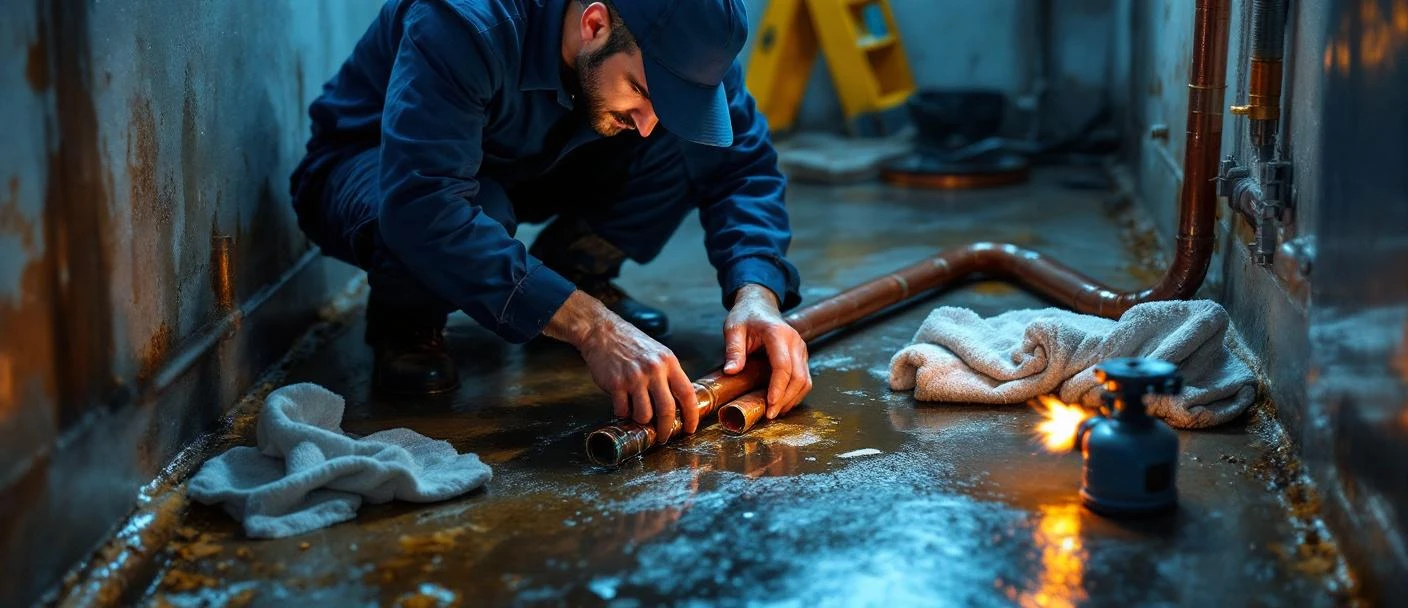
Burst Pipe Repair Chattanooga TN — when water is actively spraying inside your home, the only metric that matters is how fast a bonded plumber reaches your address with the tools to stop it. Plumbers in our network are dispatched 24/7 across Chattanooga, all Hamilton County ZIPs, and the North Georgia service ring. Average response is 45 minutes. Once on-site, the workflow is methodical: shut off main, isolate the section, dry-fit the repair, sweat or press, pressure-test, restore.
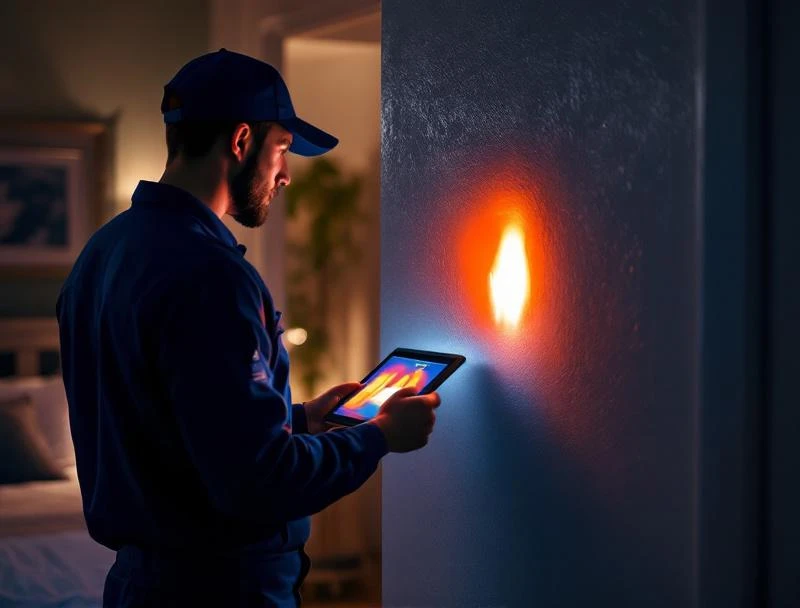
A burst pipe in a Chattanooga home is rarely a clean break. The visible damage — wet drywall, ruined hardwood, drenched carpet — usually represents a fraction of the total. Hidden water travels through wall cavities, soaks insulation, runs along floor joists, and surfaces in unexpected places like a finished basement ceiling tile in 37402. The faster the source is stopped and the materials begin drying, the less the total claim costs you.
Why the First 60 Minutes Determine Total Damage Cost
Mold begins colonizing wet building materials within 24 to 48 hours. Drywall paper, the back of carpet pad, and the underside of hardwood are all cellulose-rich substrates that grow Stachybotrys and Aspergillus fast in Chattanooga’s humid spring and summer climate. Stopping the water source within the first hour gives you a chance to dry materials before mold becomes the bigger problem.
The first action is mechanical, not technical: shut off the home’s main water valve. In 37402 downtown lofts and pre-1940 historic homes, the main is usually a gate valve near the front foundation where the service line enters. In 37421 East Brainerd post-2000 builds, the main is typically a quarter-turn ball valve in the garage near the water heater. In 37343 Hixson 1990s-2000s subdivisions, look near the laundry-room utility wall.
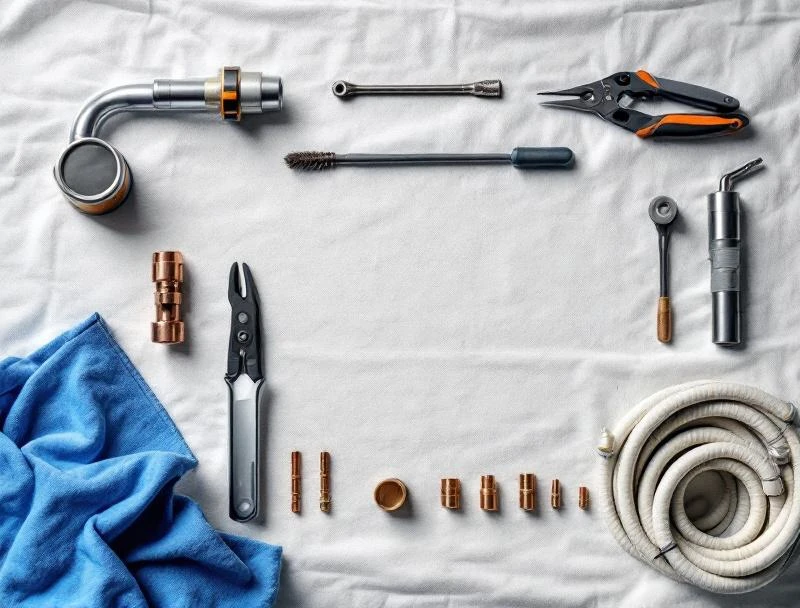
After the main is closed, pressure decays in the system over 5 to 15 minutes depending on how many fixtures are open. While that decay happens, our plumbers are loading the truck — copper repair couplings in three sizes, lead-free solder, MAPP gas torch, PEX expansion tool, ProPress jaws if the repair calls for them, and a wet-vac for cleanup-adjacent work.
Warning Signs Your Plumbing Is About to Fail
Warning Signs to Watch For
- Water bill jumped 20% or more without explanation
- Brown or rust-colored water from the cold tap (galvanized line corrosion)
- Persistent damp smell in a closet, basement, or crawlspace
- Visible green corrosion (verdigris) at copper fittings
- Stained ceiling tiles or drywall with no visible source above
- Water hammer (banging) when fixtures shut off
- Reduced flow at multiple fixtures simultaneously
- Visible white mineral deposit at any fitting or valve
The bill spike is the single most reliable early indicator. Tennessee American Water meters in Chattanooga have a leak-indicator triangle on the meter face that rotates with very low-flow leaks — even slower than a kitchen faucet drip. When the bill jumps and you can’t explain it, walk to the meter, shut every fixture in the house, and watch the triangle. If it moves at all, you have a leak somewhere on the system.
Chattanooga's water mix shapes how copper fails
Tennessee American Water reports water hardness from the Tennessee River intake at 60–90 mg/L — softer than Cincinnati’s 120-150 mg/L. The thinner copper-tube scale layer that develops in soft water gives less protection against chloramine pitting, which is why pinhole leaks tend to appear earlier in Chattanooga homes than in hard-water markets.
Bills that rise before you see water often need hidden leak detection rather than emergency burst response.
Step-by-Step Emergency Response When Water Is Spraying
- 1
Shut Off Main
Locate and close the home's main water valve. Photograph the spray for insurance before stopping it.
- 2
Kill Power
If water is near outlets or panels, shut off the affected circuits at the breaker.
- 3
Drain System
Open the lowest faucet in the house to drain remaining pressurized water from the line.
- 4
Plumber Diagnoses
Bonded plumber arrives, isolates the section, opens access, identifies repair scope.
- 5
Repair & Pressure Test
Repair coupling installed, system re-pressurized, leak walk-down at 60 PSI hold.
- 1
Shut Off Main
Locate and close the home's main water valve. Photograph the spray for insurance before stopping it.
- 2
Kill Power
If water is near outlets or panels, shut off the affected circuits at the breaker.
- 3
Drain System
Open the lowest faucet in the house to drain remaining pressurized water from the line.
- 4
Plumber Diagnoses
Bonded plumber arrives, isolates the section, opens access, identifies repair scope.
- 5
Repair & Pressure Test
Repair coupling installed, system re-pressurized, leak walk-down at 60 PSI hold.
The shut-off step sounds simple but it’s where most homeowners lose 15-30 minutes. If the main valve is corroded shut — common in 37411 Brainerd ranches where the original 1950s gate valve has never been turned — you may need our plumber to shut at the curb stop instead, which requires a curb-stop key. That’s why leak detection and main-shutoff inspection during a non-emergency visit pay back so well.
If the burst is at floor level near the foundation, a 37421 slab leak specialist may be the right next call after the water is shut off.
Why Copper, PEX, and Galvanized Lines Fail Differently
Copper pipe in Chattanooga homes spans three eras: pre-1980 thicker-wall type L, 1980s-1990s type M with thinner walls, and post-2000 type L returning as the standard for repipes. Type M is more vulnerable to chloramine pitting because the wall is thinner — pinhole leaks in 37405 Riverview homes built in the 1980s are a classic Chattanooga repair pattern.
PEX cross-linked polyethylene arrived in volume in Chattanooga’s residential market around 2000 and dominates 37421 East Brainerd and 37363 Ooltewah construction. It tolerates freeze cycles better than copper because it expands instead of bursting. When it does fail, the failure is usually at a fitting (manabloc manifold, expansion fitting, or crimp ring) rather than along the pipe wall.
Galvanized steel pipe persists in pre-1970 housing in 37411 and 37412 East Ridge for branch lines. The internal scale builds up over decades, narrows the bore, and eventually flakes off — releasing rusty water and creating turbulence that accelerates further corrosion. Galvanized failure is rarely a sudden burst; it’s a slow restriction that ends in joint rupture.
When a frozen-burst pipe is involved, the post-thaw pipe rupture response is treated as burst pipe repair rather than a thawing call — different scope, different urgency. We document the freeze event for insurance separately because some policies treat freeze damage with different deductibles than general pipe failure.
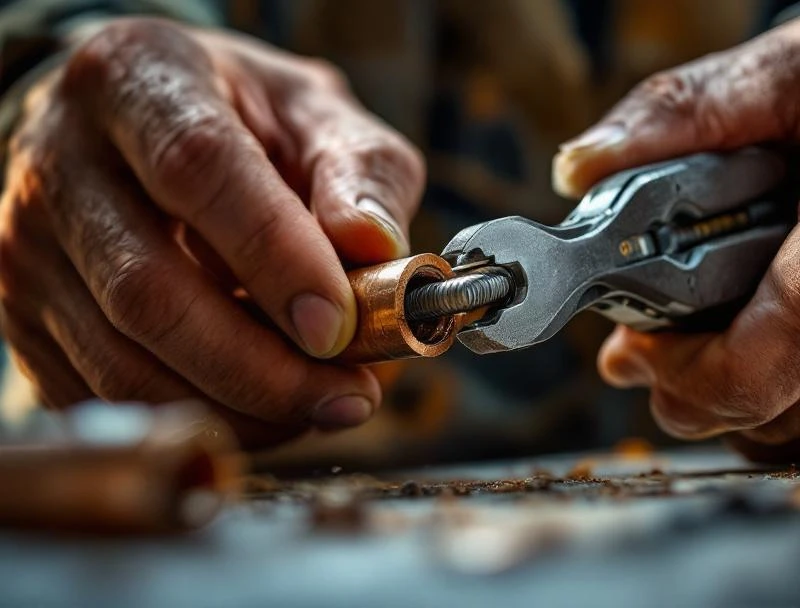
When a cold snap passes, a thorough post-freeze pipe inspection often reveals hairline splits that haven’t yet flooded a room.
If the burst is on the line feeding your tank, the technician will check whether water heater repair is also part of the same scope.
Pinhole Leak Repair
Pinhole leaks weep, then trickle, then progress to a real burst. The progression timeline depends on copper grade, water chemistry, and pressure. Chattanooga’s chloramine-treated water with 60–90 mg/L hardness causes pitting on the inside wall of type M copper that eventually breaches the wall as a pinhole.
Repair is straightforward when the leak is accessible: cut back to clean copper on both sides, deburr, install a repair coupling (sweat, press, or push-fit), pressure-test. SharkBite emergency repair couplings work for temporary patches but the Tennessee Plumbing Code prefers permanent sweat or press connections in concealed locations. Type L vs type M copper distinction matters here — when one section pinholes, others on the same era of installation are typically following.
Copper Pipe Soldering
Sweating copper is still the dominant repair method when access permits. The sequence: cut, ream, deburr, polish with emery cloth, apply water-soluble flux, dry-fit the fitting, heat with propane or MAPP gas to capillary draw temperature, feed lead-free solder (95/5 tin-antimony), wipe excess flux. ProPress is faster but requires the pipe and fitting to be bone dry — which is rarely the case in active emergency response.
For wet-pipe sweating (when you can’t fully drain the line), bread plugs upstream absorb residual water long enough to get the joint hot. The bread dissolves on the next water pass and washes through the system harmlessly.
PEX Repair
PEX repairs use one of three connection methods: expansion (Uponor PEX-A), copper crimp ring (PEX-B), or stainless steel cinch clamp. Most post-2000 Chattanooga homes use Uponor PEX-A with expansion fittings. The repair workflow uses a Milwaukee or Uponor expansion tool that mechanically expands the pipe end, slides the fitting in, then waits the manufacturer-specified time for the pipe memory to seat against the fitting barb.
When a PEX line bursts from freezing — rare but possible — the failure is usually at a fitting where movement is restricted. Replace the fitting with the surrounding 6 inches of pipe and pressure-test at 60 PSI minimum. PEX pressure-tests faster than copper because there’s no flux residue to off-gas and confuse the gauge.
Frozen-Burst Response
When a Chattanooga freeze event causes a pipe to split, the burst is rarely visible at the freeze location. The 9% volume expansion of ice produces a longitudinal split typically 1 to 6 inches long, but the water doesn’t appear until the ice thaws — which can be hours after the visible cold has passed. Hidden splits in attic and crawlspace runs in 37411 Brainerd and 37377 Signal Mountain are the dominant frozen-burst pattern in our service area.
The post-thaw response sequence: pressure-isolate the section before thaw begins, allow controlled thaw, watch for leak emergence, repair the split, replace insulation. Pre-thaw isolation prevents the catastrophic flooding that happens when a hidden split releases under full system pressure.
Never use a flame or torch to thaw a frozen pipe
Heat-gun and hot-towel methods work safely. Open flame on a frozen pipe softens copper unevenly, can ignite surrounding insulation, and frequently causes the very burst you’re trying to prevent. Tennessee fire-loss data attributes a measurable share of winter house fires to thawing-related ignition. Call rather than torch.
Water Shutoff Valve Replacement
The home’s main shutoff valve is the single most important valve in the house, and it’s the one most likely to be neglected for decades. Stuck shutoffs convert small bursts into catastrophic floods. Tennessee Plumbing Code allows either gate valves or full-port ball valves; we strongly prefer ball valves for new installs because they don’t seize.
Replacement involves shutting at the curb-side stop (Tennessee American Water meter pit), draining the house, cutting out the old valve, installing a new full-port ball valve, restoring service. Total time on a typical 37411 ranch is 2-4 hours depending on whether the curb-stop key fits or whether Tennessee American Water needs to coordinate.
Pipe Relocation After Burst
When a pipe bursts in an exterior wall during a freeze, simply repairing the split puts the same pipe in the same vulnerable location. Relocation moves the run inboard to a conditioned wall (interior wall chase) or routes through baseboard, both of which prevent recurrence. Tennessee Plumbing Code §305.7 requires pipe protection from freezing in unconditioned spaces — relocation often satisfies that code requirement better than insulation alone.
Pipe Insulation Upgrade
Closed-cell polyethylene foam sleeves with 3/8” or 1/2” wall thickness are the standard prevention scope after any freeze-related repair. For attic runs in 37377 Signal Mountain split-foyers, we add self-regulating heat-trace cable wrapped beneath the foam. Heat-trace cable requires a GFCI circuit and a thermostat that activates the cable at 38-40°F.
Pipes shall be protected from freezing temperatures by insulation or heat tape where they pass through unconditioned attics, crawlspaces, exterior walls, or other locations subject to freezing. Many pre-1980 Chattanooga homes have non-compliant runs that get updated during repair permits.
Pressure Regulator Replacement
Tennessee Plumbing Code allows up to 80 PSI static pressure on residential supply lines. Tennessee American Water occasionally delivers above that — particularly to higher-elevation 37377 Signal Mountain or 37350 Lookout Mountain TN addresses where the booster station compensates for elevation loss. When we measure 85+ PSI at a hose bib, code requires a pressure regulator (PRV) before fixture distribution.
Common PRV brands include Watts (N45B, LFN45), Wilkins (NR3XL, 70XL), and Cash Acme (EB-45). Replacement requires shutting at the main, cutting out the old PRV, installing the new with sweat or press connections, calibrating to 50-60 PSI, and code-required pairing with a thermal expansion tank to absorb the closed-loop expansion.
Water Hammer Arrestor Installation
Water hammer is the banging sound that fixtures make when valves shut quickly. The hydraulic shock creates fatigue at solder joints and crimp connections, leading to recurring bursts at the same locations. A water hammer arrestor (Sioux Chief MiniRester, washing-machine-box style) absorbs the shock with an internal piston and sealed air cushion.
Standard install locations include behind washing machine valve boxes, under dishwashers, and at any quick-closing solenoid valve. For homes with chronic banging, we install full-port piston arrestors at the main supply riser. The whole job takes 30-90 minutes per arrestor and prevents the next year’s bursts.
Pipe Re-Routing for Code Compliance
Code update requirements often trigger when a permit pull happens for repair work. Tennessee Plumbing Code §305.7 and §605 require pipe protection and approved materials, both of which can shift the scope of a simple repair into a routing change. Common conversions include moving a copper supply line from an exterior wall to an interior chase, or replacing polybutylene with PEX.
For the 25% of Chattanooga housing stock built pre-1940 — concentrated in 37402 and 37405 — copper relocation during repair is routine because the original 1950s renovation copper was installed in exterior walls before code prohibited it.
Water spraying right now?
Call our 24/7 dispatch line. Stop reading and pick up the phone — we answer in 30 seconds.
Polybutylene Replacement
Polybutylene (PB) was installed in Chattanooga homes from approximately 1978 to 1995 and is the single most failure-prone supply pipe still in service. The Cox v. Shell class action settled in 2009 (now closed); homeowners no longer have legal recourse against the manufacturer. Visual identification: gray flexible tubing, sometimes black or blue, with acetal (plastic) fittings that fail at the joint.
Whole-house repipe is the only durable fix when PB is failing. The scope: identify and map all PB runs, plan replacement routing in PEX-A, cut access in walls and ceilings, run new PEX, connect at fixtures, repair drywall. A 1,800 sq ft Chattanooga ranch typically runs $5,800 to $11,500 depending on access and finish materials.
37416 North Brainerd and parts of 37343 Hixson have notable concentrations of PB-era housing — the late-1980s subdivisions. If you’re in those areas and your house is built in the PB window, plan for replacement before the first leak rather than after the third.
Water Main Shutoff Repair
The curb stop is the utility-side shutoff at the property line, accessible through a meter pit in the parkway or front lawn. When the house-side main valve is stuck and we need to shut off water completely, the curb stop is the fallback. Tennessee American Water owns the curb stop in city limits; outside city limits, Hamilton County WWTA serves rural areas. Repair on the curb-stop side requires utility coordination — we handle that paperwork.
How Tennessee River Water Chemistry Affects Pipe Lifespan
Tennessee American Water draws from the Tennessee River intake just upstream of Chattanooga, treats it with chloramine (combined chlorine plus ammonia) instead of free chlorine, adjusts pH to 7.5-8.0, and adds corrosion inhibitor. The chloramine choice is what shapes copper pinhole patterns here. Chloramine is more aggressive against copper than free chlorine over a 25-year horizon, and the soft water (60-90 mg/L hardness) doesn’t lay down a thick protective scale.
Static water pressure on Signal Mountain (37377) at 600+ feet elevation runs through different terrain than valley-floor 37402 — service lines climbing the mountain require booster pumps and pressure-management consideration. Pressure transients during booster cycling cause water hammer that accelerates fitting failures.
Pre-1940 housing makes up roughly 25% of Chattanooga’s stock — 37402 and 37405 contain most of it. Most still have at least some galvanized supply line. Homes in 37421 East Brainerd built post-2000 are predominantly PEX, requiring expansion-fitting tooling. Hamilton County Department of Health requires private-well testing for homes outside city water in 37363 Ooltewah and 37302 Apison, where well-pressure tank failures sometimes manifest as burst events.
Tennessee Plumbing Code Requirements for Repipe Sections
When the burst-repair scope crosses certain thresholds, a permit is required from Chattanooga Codes & Construction Services (city limits) or Hamilton County (outside city). Threshold rules of thumb: any work exceeding $25,000 in value, any change to fixture count, any work in a load-bearing wall, any concealed-space repair. A simple in-line copper repair behind drywall doesn’t require permit; a full-house repipe does.
The permit process involves an application with scope description, plan submittal for major work, an inspection appointment after rough-in, and a final inspection after finish. Tennessee Plumbing Code follows the 2018 International Plumbing Code with state amendments. The plumbers in our network handle the permit pull and inspection coordination as part of any covered scope.
Approved materials for water service piping include copper (type K, L, M), CPVC, PEX (with appropriate fittings), polyethylene (for service line outside foundation), and stainless steel. Polybutylene and lead are prohibited for new construction. Identification of existing PB during repair triggers replacement scope discussions.
Brands We Repair and Recommend
Pipe & Fitting Manufacturers
When DIY Shutoff Works and When You Must Call a Professional
| Situation | DIY Action | Call Plumber |
|---|---|---|
| Visible drip from a single fitting | Tighten with wrench (gentle) | If drip persists or worsens |
| Frozen pipe, not yet split | Hot towel wrap, heat gun (no flame) | If hidden or multi-hour frozen |
| Active spray from accessible burst | Shut main valve, drain system | Always — same hour |
| Toilet supply braided line burst | Close angle stop, replace line | If angle stop won't close |
| Whole-house pressure surge | Shut main, call gas company too | Always — possible water hammer fault |
| Pinhole leak weeping | Capture with bucket, photograph | Schedule within 24 hours |
| Brown water from cold tap | No DIY action effective | Schedule for galvanized line eval |
| Bill spike with no visible leak | Run meter triangle test | Schedule for hidden leak detection |
Process Timeline: From Call to Completion
- 1
Call Received
Real dispatcher answers in under 30 seconds. Address, situation, ETA confirmed.
- 2
Plumber En Route
Closest available bonded plumber dispatched. Average 45 min Chattanooga.
- 3
On-Site Assessment
Visual inspection, water shut-off verification, written estimate before work.
- 4
Active Repair
Section isolated, repair installed (sweat, press, or PEX expansion).
- 5
Pressure Test & Restore
60 PSI hold for 15 min, walk-down at all fixtures, work complete.
- 1
Call Received
Real dispatcher answers in under 30 seconds. Address, situation, ETA confirmed.
- 2
Plumber En Route
Closest available bonded plumber dispatched. Average 45 min Chattanooga.
- 3
On-Site Assessment
Visual inspection, water shut-off verification, written estimate before work.
- 4
Active Repair
Section isolated, repair installed (sweat, press, or PEX expansion).
- 5
Pressure Test & Restore
60 PSI hold for 15 min, walk-down at all fixtures, work complete.
What Every Service Call Includes
- Written estimate before any work begins
- Upfront pricing with no hidden fees
- Bonded and insured plumbers in our network
- Background-checked plumbers dispatched to your home
- Same-day emergency response across Hamilton County
- Workmanship stands behind the repair
Service Cost Calculator
Quick Estimate
Estimates are approximate. Call for written quote.
Before & After: Pipe Failure to Permanent Repair
Active leak situation
- Water spraying from split copper
- Drywall and insulation saturating
- Hardwood floor warping along run
- Water bill projected to spike $200+
- Mold growth window 24-48 hours
- Insurance claim documentation incomplete
Repaired and protected
- Section replaced with new type L copper
- Pressure tested at 60 PSI hold 15 min
- Wall cavity dried and inspected
- Photos documented for insurance
- Insulation upgraded to closed-cell foam
- Water bill returns to baseline
Why a Hissing Sound Near Walls Means Immediate Action
A faint hiss in a wall cavity, audible only when the house is quiet, is a slow-flow leak — usually a pinhole spraying mist into the wall. By the time you hear it, the cavity has been wet for days. Open the wall, find the source, repair, dry. The total job cost for a hidden pinhole caught early is $485 to $885 . The same leak ignored for two months runs $3,000+ once mold remediation enters scope.
Why a Pipe That Froze and Thawed Still Needs Inspection
The 9% volume expansion of water freezing inside a pipe stresses the wall even when no visible split forms. Hairline cracks can develop that don’t leak under static pressure but fail when water hammer hits during a fixture cycle. A 20-minute pressure-decay test on the affected section after a freeze event identifies these stressed sections before they become next month’s burst.
Service Stats
When a burst happens after hours, our Emergency Plumber Chattanooga dispatch keeps lines open every day of the year.
What This Service Costs in Chattanooga
| Service | Chattanooga Range | Time Required |
|---|---|---|
| Single accessible pinhole leak (37411 Brainerd ranch) | $285 – $485 | 1 – 2 hours |
| 1/2" copper repair behind drywall (37405 historic) | $385 – $725 | 2 – 4 hours |
| PEX section replacement, 2 ft (37421 East Brainerd) | $245 – $395 | 1 – 2 hours |
| Frozen-burst attic repair (37377 Signal Mountain) | $485 – $1,150 | 2 – 5 hours |
| Galvanized-to-copper conversion, single section (37402) | $650 – $1,250 | 3 – 6 hours |
| Polybutylene whole-house replacement (1,800 sq ft) | $5,800 – $11,500 | 2 – 4 days |
| Main shutoff valve replacement (curb-side) | $385 – $685 | 2 – 4 hours |
| Pressure regulator replacement (80+ PSI) | $385 – $585 | 1 – 2 hours |
| Hose bib freeze-burst repair (37343 Hixson) | $285 – $485 | 1 – 3 hours |
| Water hammer arrestor at washing machine box | $185 – $285 | 30 – 90 min |
| Toilet supply line burst with cleanup-aware repair | $245 – $385 | 1 – 2 hours |
| Slab-adjacent burst (above-slab, against foundation) | $485 – $925 | 2 – 4 hours |